AI Generated Effects — Effect House
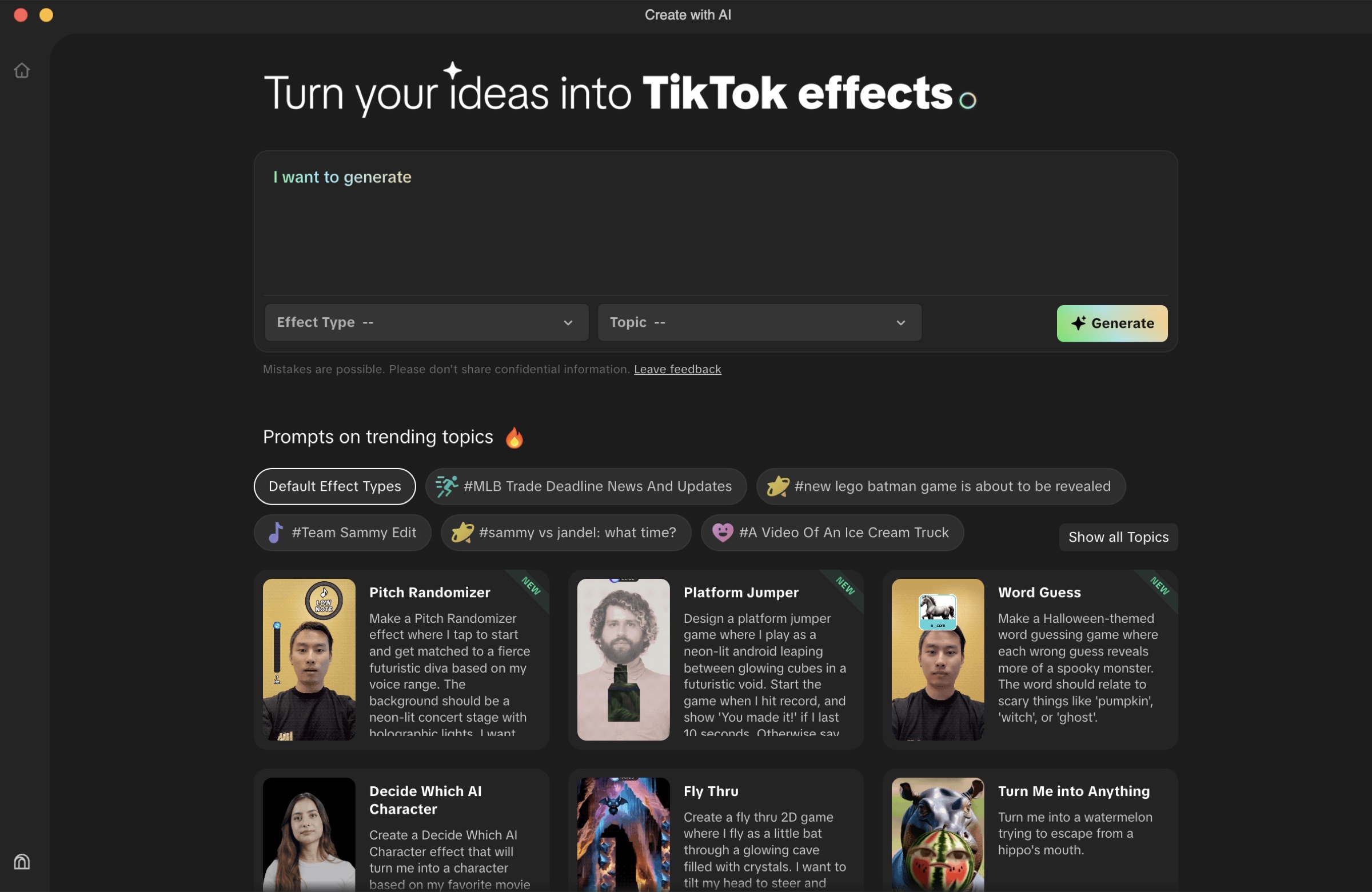
Architected the framework powering Create with AI in TikTok Effect House — a feature that lets a creator type a short prompt and receive a fully playable AR mini-game complete with custom art, mechanics, and the underlying visual-scripting graph, ready to publish or refine in the editor.
The Feature
Public documentation: Create with AI — Effect House Learn ↗
Inside Effect House, a creator clicks Create with AI and supplies an English-language prompt — keywords describing style, subject, environment, and atmosphere — optionally seeded by one of the available templates. The system returns an interactive AR effect with a live preview; the creator can publish it as-is or open it in the editor to customise further.
At launch the feature shipped 13 generatable effect types spanning interactive games (2D Blocks Game, Road Fury, Drop It, Cross Street), choice-based effects (Random Picker, Decision Maker, Personality Test), reveal mechanics (Flip Reveal, Scratch to Reveal), character transformations (Transform Me, Which AI Character Am I, Flip Reveal AI Character), and social integrations (Social Randomizer using a creator's TikTok friends).
Architecture I Built
I designed and built a TypeScript framework that compiles a natural-language prompt into the visual-scripting graph and accompanying assets that make up a runnable AR effect inside Effect House.
The pipeline runs in two stages with a structured intermediate representation between them:
- Stage 1 — Content. A constrained LLM call produces a structured description of the game (the entities, conditions, animations, UI states, and player instructions) that an AR mini-game of the requested style would need.
- Stage 2 — Compilation. The framework walks that description and emits a graph of runtime components and node connections, wiring up the visual-scripting logic that drives the effect.
Anything that's the same across every effect — graph wiring, component instantiation, the baseline shape of the intermediate document — is handled by the framework. Anything that's specific to a given mini-game lives in a small set of extension points that a skill developer (another engineer on the team) fills in. The result is that adding a new mini-game type is a contained task, not a cross-framework rewrite.
Constraining the LLM
Each class of mini-game defines its own constraint set: what mechanics, win/lose conditions, animation types, and entity quantities the LLM is allowed to produce inside it. Those constraints are part of the prompt the framework hands to the model, which keeps generated content valid for the runtime and the editor instead of free-form drift that would fail to compile.
This guard-rail layer was as much a part of the work as the compiler — much of the framework's reliability comes from refusing to ask the LLM questions whose answers the runtime couldn't honour.
The Skill-Developer Extension Point
Between content generation and graph compilation, the framework hands off to the skill developer for a composition pass — a chance to layer in skill-specific structure that the generic constraint set can't express on its own. That output gets folded back into the intermediate document so the compilation stage sees a single unified source of truth.
After the framework emits the base graph, the skill developer layers on bespoke adjustments — entity placement, scale, rotation, animation direction — referencing the stable handles the framework has already created. AIGC image generation is wired into the same step so that the runtime materialises the AI-authored art alongside the graph it lives in.
Impact
- 10K+ AI-generated effects supported on launch, the majority authored by first-time Effect House creators.
- Materially reduced creator onboarding friction by lowering the technical floor required to ship a functioning AR effect from "learn the visual scripting editor" to "type a prompt."
- Established the framework pattern other engineers on the team extend to add new mini-game classes — adding one is a contained, skill-developer-owned task instead of a cross-framework rewrite.